This page contains tips and resources for parents and carers to help young people stay safe and healthy when gaming. Download this page as a PDF (157KB) or Word .docx (1.2MB).
What can parents do?
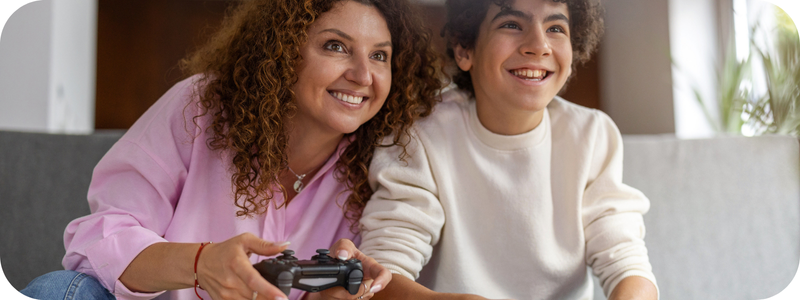
Gaming is a part of everyday life for many young people but can seem complex and confusing to parents and carers. While gaming comes with many benefits for young people's development and wellbeing, it's important to understand the risks and potential harms, and how to keep your child safe.
On this page
How much is too much gaming?
It's not about the amount of time they spend gaming, it's about the impact their gaming is having on their health and wellbeing. If gaming is taking over parts of their life such as school work, socialising with friends, eating and sleeping habits, household chores and responsibilities, personal hygiene, and physical health, it could be time to talk to your child about their gaming, or seek advice.
LEARN MORE: Check for signs that gaming is becoming an issue and find support.
Recognise signs of gaming addiction
Most people never experience any issues with gaming, but for a very small amount of people it may become a problem or an addiction. With many popular games using simulated gambling, or gambling-like game mechanics to keep people playing and spending more, it's important to recognise the warning signs before your kids experience harm.
LEARN MORE: Why gaming can be addictive.
Understand the games they play
- Check the Australian Classification website for ratings and suitability of video games at www.classification.gov.au
- Understand gaming terminology (search 'gaming terminology' for many online resources)
- Read game reviews. Check out Common Sense Media at www.commonsensemedia.org
- Find information about or report online abuse or cyberbullying at eSafety www.esafety.gov.au
Get involved
Young people are more likely to seek help from parents and carers if they show that they are willing to talk about, and get involved in, the games they enjoy.
- Talk with your child about their gaming and who they play with online. Support their positive connections while helping them understand the risks.
LEARN MORE: Talking to young people about gaming. - Play alongside your child or watch their gaming to get a better sense of how they are handling their personal information and who they are communicating with.
- Take an interest by asking about the storyline or characters in the game if you don’t feel comfortable playing the game yourself, or your child doesn’t want to play with you. Use eSafety’s guide to Better conversations about gaming for families to help you.
- Encourage your child to tell you if they experience anything that worries them or makes them uncomfortable.
- Monitor the time your child spends online and watch for any changes in their activity, school or social behaviours, in case something might be wrong.
LEARN MORE: Visit the eSafety website for more information and advice for parents about gaming.
Set some guard rails
If you are worried that gaming is having a negative affect on your child's health, wellbeing and relationships, these practical tips may help them find the right balance for staying happy and healthy.
- Limit screen time or set times to ‘unplug’ from all games and devices.
- Make mealtimes screen-free.
- Encourage regular breaks.
- Find other hobbies and interests to enjoy regularly.
- Use password protection and parental controls on devices.
- Set spending limits on in-app purchases.
Understand why young people love gaming
From the outside, it's not always easy to understand why your child wants to game so much, or what they get out of it. Common reasons why they love gaming include:
Progression is the objective of most games. For example, getting to the next level, beating a high score or defeating an enemy. There is an intrinsic reward for these achievements – a sense of accomplishment. But players are also rewarded in a more tangible way. For example, by gaining ‘experience points’ that give them access to new weapons or improved character attributes. Many teens seek out opportunities to be challenged and improve their skills and gaming offers a way to achieve mastery.
Online gaming can be a highly social activity for young people, and an important part of feeling accepted by their peer group. For young people who feel anxious socialising in-person, gaming can provide a less threatening way to connect and build confidence.
Unfortunately, bullying can also occur within games. Known as cyberbullying, it can include verbal abuse, targeted harassment and exclusion.
For information about what you can do to prevent and respond to cyberbullying, visit esafety.gov.au.
The most obvious reason for gaming is that it’s fun! Gaming is a highly stimulating and heightened sensory experience. Gamers actively participate and drive the action, unlike more passive activities like watching TV. Video games are designed to be as engrossing as possible. This is what keeps people wanting to play. Through gaming, people can sometimes experience ‘flow’, that is, a state of optimal focus and engagement. Often, people also refer to this as ‘getting into the zone’.
What else can parents and carers do?
Ask your child's school to host a free Be Ahead of the Game workshop for students about the risks of gaming. Find out more.
Need support or advice?
Worried that your child is experiencing issues from gaming? Kids Helpline offers great information and support for kids and parents on gaming addiction.
Call Kids Helpline on 1800 55 1800, send an email or chat to someone via WebChat.
Download this page as a PDF (157KB) or Word .docx (1.2MB).